
I would prefer not to.
week 4 : anatomy of a refusal

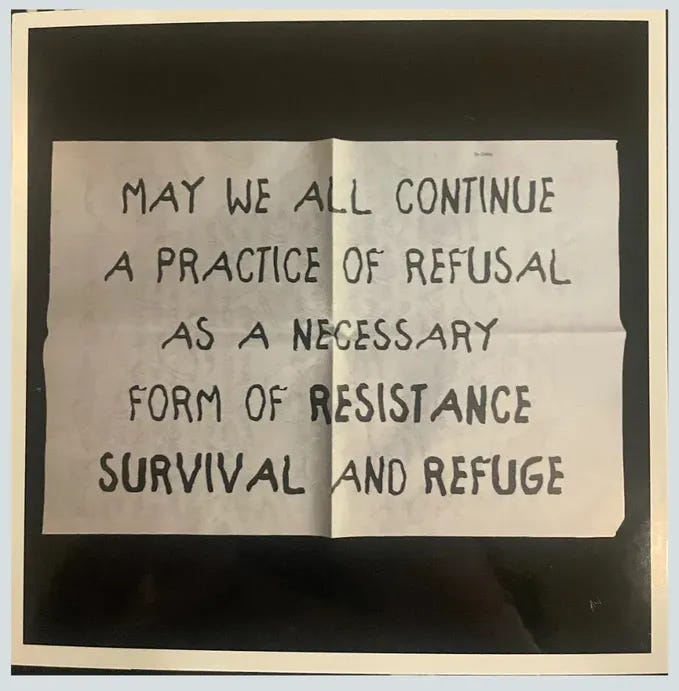
week 4/chapter 3 Anatomy of a Refusal
“I would prefer not to.”
Bartleby
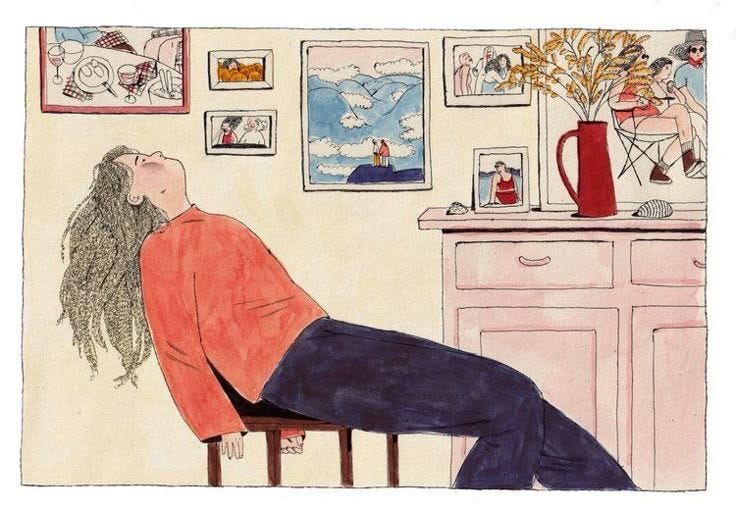
“Let your life be a counter-friction to stop the machine.” Thoreau
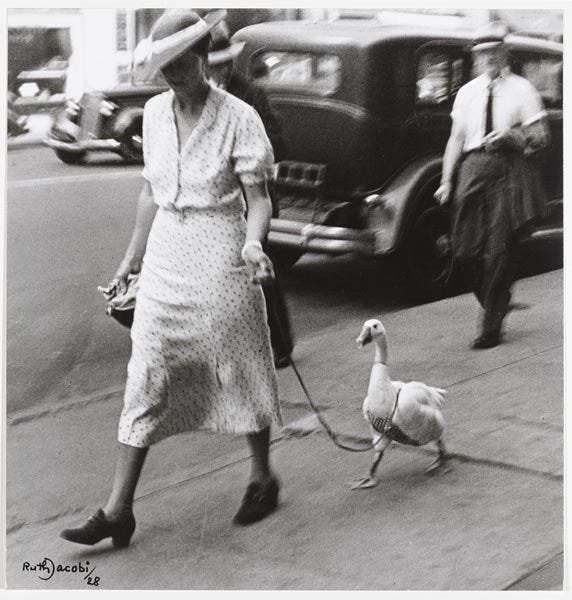
“At their loftiest, such refusals can signify the individual capacity for self-directed action against the abiding flow; at the very least, they interrupt the monotony of the everyday.” Jenny Odell
This week’s reading was packed with historical context and ideas for refusal in place, which Odell states is a strategy, not a retreat, and in fact, is a deep engagement with culture.
It is doing things and not doing things as society expects.
Beyond this book, I am interested in considering these refusals in the domestic space. I had a friend who was annoyed that no one would empty the silverware from the dishwasher, so they just started dumping the utensils in the drawer in a heap. The family was shocked, and although it was in jest and maybe seemed silly, the rule-breaking and refusal to continue unseen labor opened a space for conversation and questions about expectations and standards.
I particularly liked thinking about Bartleby, a character’s story I read in college and have never forgotten. I was laughing about it and telling my son the story, and he said, “Hmmmm…. That’s exactly what I do to you.” And he was right! I ask him to do something, and instead of outright refusing, he undermines the question itself through obfuscation and quiet refusals - thus driving me mad! I think teenagers might be master Bartlebys.
Questions
The real power of this chapter comes with engaged reflection. Below is a list of possible journal prompts and discussion ideas. Track the places you found yourself interested, frustrated, in (dis)agreement, or inspired.
Dig into your own hustle mentality - that which you were raised in and that which you live in now. Are you a 24/7 worker or something else?
How do you refuse in place?
What arenas do you want to refuse in? Work, school, interpersonal relationships, politics, community…..
Do you think weapon zed incompetence is a type of refusal? Where do you see this?
What are some strategies or ideas you can develop to further refuse in place?
When have you felt the oddity or surreality of life and realized we are all performing?
Can you connect ways ou have been anticipatorily compliant? Ways you have refused the premise altogether?
How can you gain distance from your reality to better discern it? (the higher mountain/the fountainhead - Thoreau, dragged into the light - Plato)
How can you work with others to create space and support for collective refusals that can become a “spectacle of noncompliance”?
Who defines justice?
What would training your attention look like in your life?
Most of the examples Odell offers are from men artists, writers, and thinkers. How is refusal a gendered experience? Compare the stakes for men and women?
Other Voices
So much goodness and fascinating reading in the list. Choose something to rabbit hole.
Tom Green, Dead Guy
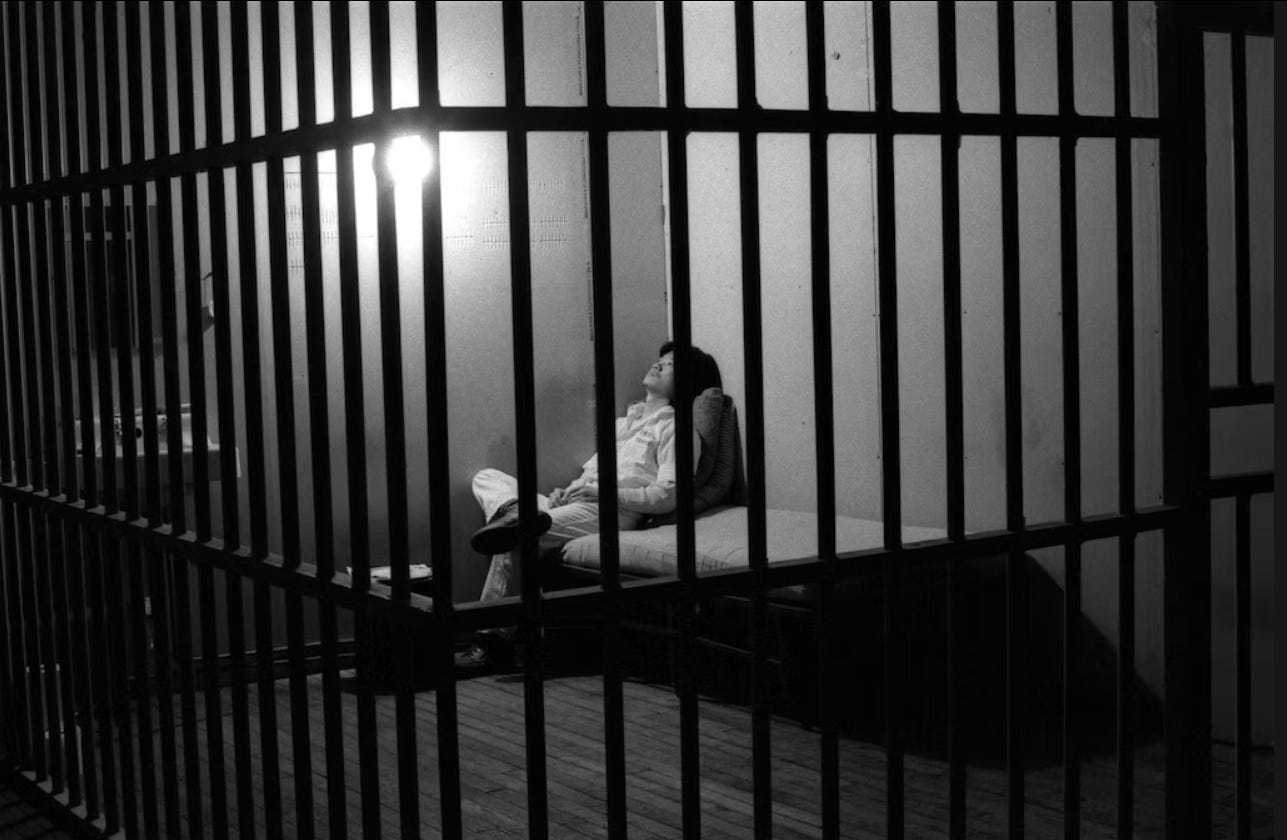
Tehching Hsieh, Cage Piece, 1978
Henry David Thoreau, Walden & Civil Disobedience
Taft-Hartley Act 1947 - intended to hobble the collective power of workers in support of capitalism
Jonathan Crary 24/7 Late Capitalism and the End of Sleep
Lexicon
Vocabulary of refusal
Disingenuous compliance
Over identification
3rd place
atomized
Notes
These are a direct copy of my notes, which might or might not be useful to you. Ignore if they are a distraction.
Diogenes flips it all upside down and suggests we are all in ane for going along with life as it is. Life is performance art.
3rd space - I will participate, but not as asked. This refusal makes others crazy and stops their progress. Does not have to be (is not) adversarial.
Refusal “exposes and inhabits a space around the original question, undermining authority.” This makes me th k of Timothy Snyder’s work on tyranny. The first point in his 20 lessons is:
1. Do not obey in advance. Most of the power of authoritarianism is freely given. In times like these, individuals think ahead about what a more repressive government will want, and then offer themselves without being asked. A citizen who adapts in this way is teaching power what it can do.
Cicer - there is no ethics without freewill. We might have tendencies, but we are still free to perform acts that will go against those tendencies. “...A man may build a character quite at variance with his natural disposition.” (Margaret Y. Henry, writing about Cicero).
How do we inhabit that third space?
voluntate (will)
studio (desire, Latin for study)
disciplia - training
We have to have social stamina, the ability to be uncomfortable, to not sell out.
Tehching Hsieh, performance pieces, mastery of self (Time Clock Piece, Outdoor Piece, Rope Piece, No Art Piece). He says these are not endurance pieces but exercises in will. What is the difference?
We seek to FILL our lives with meaning, but what if we empty them instead? An experiment in subtraction.
Thoreau’s Civil Disobedience, “If (the law) is of such a nature that it requires you to be the agent of injustice to another, then, I say, break the law.”
Plato’s Cave - you can’t see something clearly when you are inside it
The stakes of our attention are clear; distraction is bad individually and collectively. It steals agency and action.
The attention economy has shaped our collective brains to react, mostly out of fear and anger
Refusal shouldn’t be an emotional reaction but a committed plan of action. It is also often a privilege afforded by those who can absorb the consequences.
Rosa Parks lost her job and health for her work.
Diogenes had an easy time because of the mild Greek weather and mild politics
Thoreau had patrons who paid his tax bill and provided the land for his cabin
Greensboro sit-in students had institutional support, whereas working adults had much more at stake
When we make the conditions worse for workers and citizens, and strengthen business, the margin for refusal becomes thinner out of economic fear, creating precarity.
Apply this perspective to students, and we see a significant impact on their well-being. The stakes are higher at a younger age, and they are being raised as a future workforce above much else. Ugh.
Attention economy, systematic abuses, just leaving Facebook is not impactful. Go beyond a digital detox and instead change the system. Create a non-commercial social media. Be like Bartleby and refuse the terms of the question.
We must wake up from the stupor and be like the island Pera (imagined by Crates, student of Diogenes). This island is not affected by the storm. Our minds have the potential to be like Pera. How do we get there?
voluntate, studio, disciplinia
To withdraw your mind is not big and dramatic (no LOUD quitting!) but is made up of lots of tiny actions and training.
Withdraw your attention and invest elsewhere to improve acuity.
Investigate different time scales.
Understand clickbait.
Look for context over unchecked outrage.
Study ways the media plays on emotion.
Attention is the one kind of refusal we can easily make.
“...drills and formation of attention within the mind represent a primary space of volition.”
Train to build capacity.

Activities
Copy Work (the lawyers’ shock at Bartleby’s quiet but impactful refusal)
”For an instant I stood like the man who, pipe in mouth, was killed one cloudless afternoon long ago in Virginia, by a summer lightning, at his own warm window he was killed, and remained leaning out there upon the dreamy afternoon, till someone touched him, when he fell.”
After working through some of the questions above and thinking about your own relationship with compliance and refusal, create a list of joyful refusals. What would it look like to refuse a norm you find disagreeable but also create, amplify, and inject joy into that immoral space?
Make a one-page handwritten zine of ways to train your attention. Make copies and share.
Choose one of the artists or writers to dig into and read/watch. Reread Thoreau or Melvil e. Or check out Pilvi Takala’s website. Think of it as a 30-minute or 1-hour field trip of the mind.
When scrolling social media, screenshot or share a post with notes analyzing how the post incites outrage, is incorrect, or otherwise nefarious.
It is about quiet refusal, but he starves himself to death in a prison at the end :(
But Bartleby is about futility and alienation.