
if you could ever get far enough away from earth, would you understand it?
Orbital week 4

Before we dig into Obrit 5, enjoy this rendition of David Bowie’s Space Oddity by ISS astronaut, Canadian, Chris Hadfield. It is perhaps the most poignant music video made.
I have read a lot of reviews of Orbital where readers lambast it for being too slow, too poetic, too plotless…
I agree. If you are expecting an adventurous science fiction book to lose yourself in and read in a day, this is not it. For me, reading a section a week (usually on Friday or Saturday) is perfect. I look forward to my weekly reading and the space it creates as I transition from the work week to the weekend. I find myself absorbed, contemplative, and connecting the themes Harvey explores with my own life.
It is restorative. I am curious if it works like that for you?
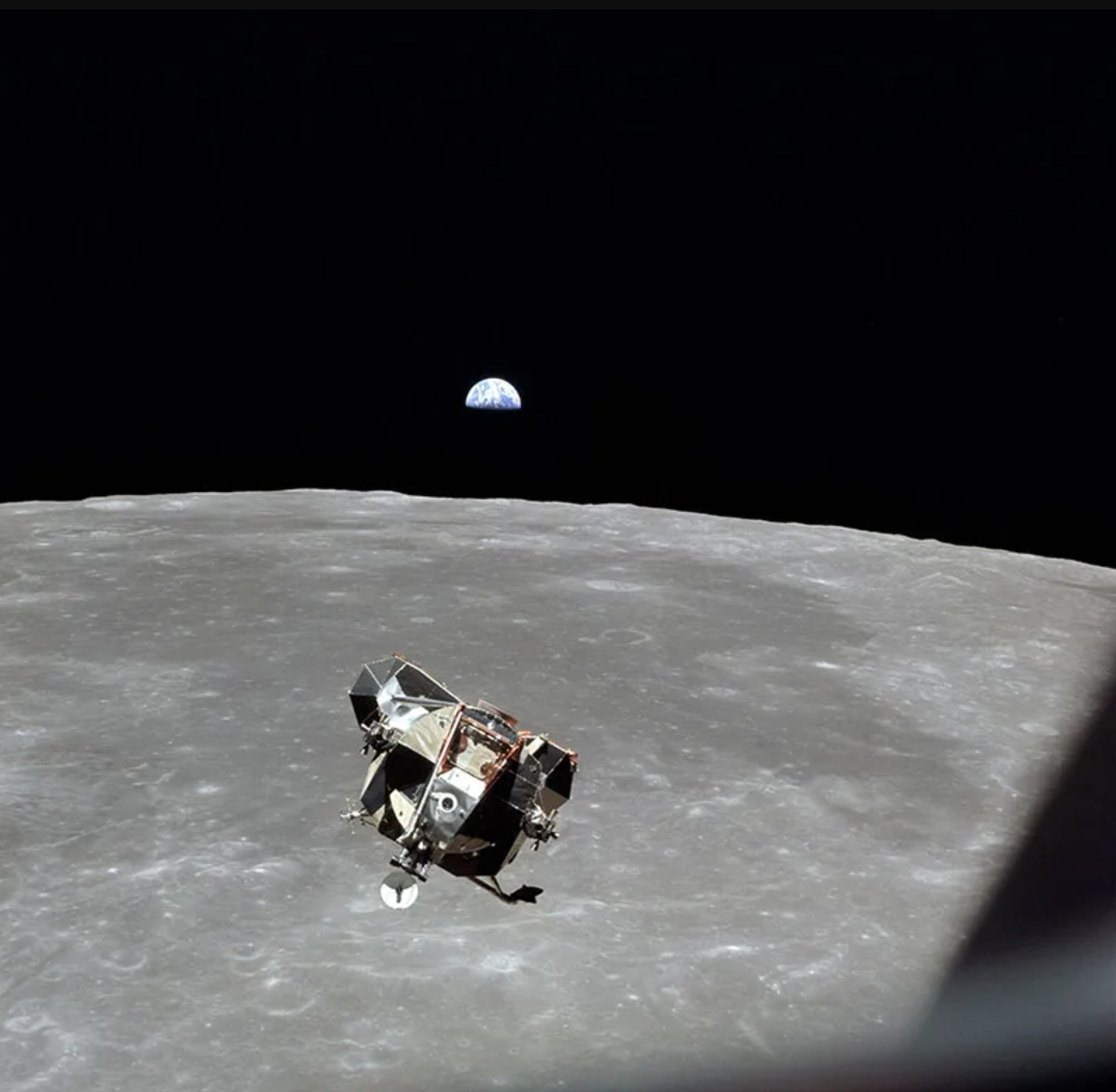
In this week’s reading, I really loved the continued meditations on photography and the power of images and, more broadly, looking/seeing.
Michael Collins’ famous image creates an interesting puzzle of perspective. It is commonly thought of as uniquely lonely because Collins is the only person in the human world NOT in the photo. But Anton flips this idea to posit that Collins is the ONLY person IN the picture because it is what he sees, what he made, and how he perceives the world. He is both the viewer and the artist, and without him, the scene would not exist as an image.
When I look at it, I try to imagine what it would feel like to be on a ship alone so far from home, safety, and my crewmates. It must have felt like a surreal privilege. I am listening to moody cello music as I write this, which is the musical equivalent of how this photo makes me feel.
Later, Chie, still thinking about her mother, reflects on the snapshot her mom gave her before the mission: a picture of her mom on the beach looking up, scowling at the sky as Apollo landed on the moon. Chie recounts her mother’s fortuitous escape from the atomic bomb and views her mom in the image, and in life as static:
“…the world blurring past her while she stayed still.”
Chie feels invincible and courageous because of her mother’s “slipping through the crack, the fissure of history,” and creates imagined meaning in the photo, the notes on the back, and her mother’s intention. For several pages, she writes in her mother’s voice what she, Chie, wants to hear, but in the end, confesses,
“It’s just imaginings and projections, and they could all be wrong.”
It makes me think of the myth-making around photos and stories that become lore, where the needs of the family create the stories they seek to guide them. Maybe you have examples of this in your history?
A final thought from Pietro reminds me of an interview I once read/viewed of James Baldwin.
Pietro thinks:
“It's probably a childish thought, but he has an idea that if you could get far enough away from the earth you’d be able finally to understand it — to see it with your own eyes as an object, a small blue dot, a cosmic and mysterious thing. Not to understand its mystery, but to understand that it is mysterious. To see it as a mathematical swarm. To see the solidity fall away from it.”
Baldwin said something along the lines of “I had to leave America to understand (write about) America.”
This idea and desire for distance feels like a welcome idea today as the world, delivered through our devices, seems to be in a persistent agonal breath cycle.
The distance we need to fully perceive or comprehend, or even begin to untangle ourselves from, is hard to get. The ISS is only 250 miles above us and transforms its astronauts - but how can we get that on earth? Travel is good, but tenuous now for some. Maybe by disconnecting from the media and even others who bring the anxious world energy into your relationship? Can we time-travel by reading or studying ancient or far-future cultures? Maybe.
I don’t really know, but it feels like there is a remedy in this idea that I want to locate.
What resonated with you this week in Orbital?
Also, I have added a few more videos to the Orbital YouTube playlist, mostly content videos related to the novel, including a HAM radio operator who makes contact with the ISS (not that hard apparently), a Buddhist death ceremony including the bone ceremony, coverage of the first moon landing and Challenger disaster, and more.

Much love as we move through the week. See you Wednesday for a creative prompt (please consider subscribing if you think that might interest you.)
"It makes me think of the myth-making around photos and stories that become lore, where the needs of the family create the stories they seek to guide them. Maybe you have examples of this in your history?" I'm sure I do - going to ponder this.
Again, many of the same moments and excerpts stood out and resonated for me.
The sharing of the astronauts' dreams pulled me in as did the Challenger and the ways that these collective shared events: Challenger, moon landing, sit on our psyches, our collective psyches.
The section about Shaun and Nell and their differing views: "trivial and insurmountable.
And, of course, this line: "projections of all the sad frustrated men of America."
I love the James Baldwin connection you drew, which also seemed relevant when Shaun talks about trying to live where you can never thrive and how this is the experience of so many right now...
And how, maybe, these little bits of beauty, like this book and experiencing it with others, can nudge about toward the goal of a world where we can all thrive.