Today in the Wrack Lab, we kick off a sensory zine series that supports the slow read of How To Do Nothing by Jenny Odell. (zine download below).
You do not have to be reading the book to play here, but check out the posts because I think the notes and links are useful.
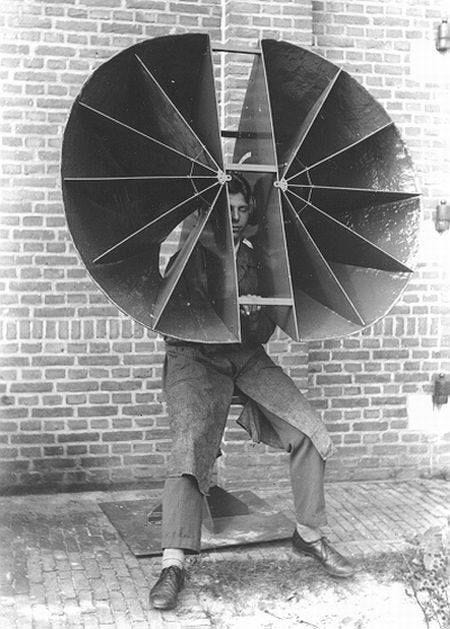
Dutch/German parabolic acoustic helmet from the 1920s
This week, we are thinking about sound, specifically Pauline Oliveros’ book Deep Listening, which showed up in chapter 1 of HTDN and happened to be on my bookshelf from another source’s recommendation. This book keeps showing up in my life, so it seems like the time to dig in and share.
about Oliveros from her website:
Pauline Oliveros' life as a composer, performer and humanitarian was about opening her own and others' sensibilities to the universe and facets of sounds. Her career spanned fifty years of boundary dissolving music making. In the '50s she was part of a circle of iconoclastic composers, artists, poets gathered together in San Francisco. In the 1960's she influenced American music profoundly through her work with improvisation, meditation, electronic music, myth and ritual.
…
.
Oliveros was Distinguished Research Professor of Music at Rensselaer Polytechnic Institute, Troy, NY, and Darius Milhaud Artist-in-Residence at Mills College. She founded "Deep Listening®," which came from her childhood fascination with sounds and from her works in concert music with composition, improvisation and electro-acoustics. She described Deep Listening as a way of listening in every possible way to everything possible to hear no matter what you are doing. Such intense listening includes the sounds of daily life, of nature, of one's own thoughts as well as musical sounds.
"Deep Listening is my life practice," Oliveros explained, simply. Oliveros founded Deep Listening Institute, formerly Pauline Oliveros Foundation, now the Center For Deep Listening at Rensselaer, Troy, NY. Her creative work is currently disseminated through The Pauline Oliveros Trust and the Ministry of Maåt, Inc.
The short book (under 100 pages) is filled with practices and exercises, as well as short essays from Oliveros and commentaries from students and colleagues on the effect of her methods. She invites students to listen to their body rhythms, the sounds of passing cars, nature, and to make voluntary sounds and compositions in community.
Maybe you have noticed that many people now wear headphones, all day, every day, to block out the sounds of the world. We feel overwhelmed, and sensory deprivation seems like an easy fix. After reading Deep Listening, I wonder if the opposite might be true. Sure, some things should probably be blocked out, but maybe the bombardment of digital information instead of somatic information is a direction to explore.
It might be a misdirection and a disservice to block our senses.